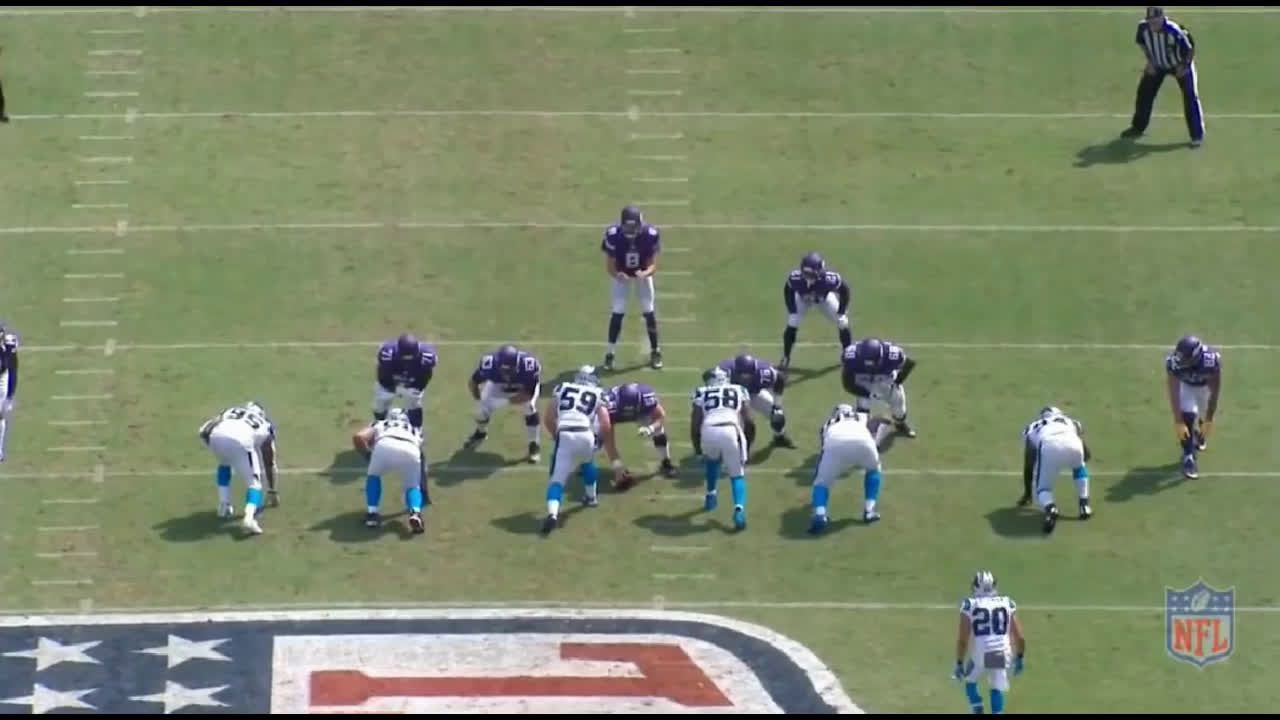
Analyzing the Carolina Panthers 2019 Draft Picks

The NFL Draft is now over. There were some obvious picks (Kyler Murray at no. 1, Nick Bosa at no. 2) and some shocking picks (Clelin Ferrell at no. 4, Daniel Jones at no. 6), but past the first round, teams mostly picked who we thought they would pick. There’s one exception, however, and it’s a big exception, that occurred in the 3rd round of the draft. With the 100th overall pick, the Carolina Panthers selected Will Grier, a phenomenal quarterback out of West Virginia. Before the draft, many said he was the most pro-ready quarterback in the draft, as he’s 24 years old, and performed very well at his pro day, along with great clutch performances late in games. So, I would like to analyze this pick, along with all of the other six picks from the Carolina Panthers.

No. 16 overall: Brian Burns

Brian Burns on Draft Day

Bias excluded, I believe Brian Burns was a top-5 defensive talent coming into the draft. Although he’s lighter than most conventional 4-3 defensive ends, he can fit into almost every scheme, as he can drop back into coverage, burn top offensive tackles 1-on-1, and bust through double teams, as he’s shown in his time at FSU. He has defensive rookie of the year potential, and perennial all-pro potentially in a couple of years if he develops well. I believe this could very well turn out to be the steal of the first round, if not the entire draft, as there were 7 pass rushers drafted before him.

No. 37 overall: Greg Little

Greg Little

The Panthers gave up an early 3rd round pick to move up 10 spots to take Greg Little, an offensive tackle out of Ole Miss. Although the trade was bad, as they probably could’ve traded their 100th overall pick instead of their 77th pick, they got their guy at LT, which is a much-needed position for the Panthers. He’s a little week in run protection, but is a fantastic pass protector already and should highly benefit the Panthers in 2019.

No. 100 overall: Will Grier

Will Grier

You can spin this however you want. The Panthers spent a 3rd round pick on a backup quarterback. I don’t care how good of a player you think he is, you aren’t drafting to replace Cam Newton. Ron Rivera, the Panthers HC, gave an example of Nick Foles winning the Super Bowl for the Eagles to show how important a backup quarterback can be. But I believe he’s wrong. The Eagles roster was stacked, and Doug Pederson knew what he was doing to coach schemes that Foles could run. If Newton is going to be out for the entire 2019 season, and you think Will Grier can step up and at least take you to the playoffs, then I like the pick. But GM Marty Hurney said Newton should be good to go by the start of the season. If Newton goes down, the season is over. As simple as that. A backup quarterback won’t do you any good. I do not like this pick at all.

Rounds 4-7: Christian Miller, Jordan Scarlett, Dennis Daley, and Terry Godwin

In the later rounds, the Panthers grabbed two guys I really like, and two guys that I doubt will become anything. Christian Miller is an edge rusher from Alabama, and I really like the pick. Just like Burns, he’s a lighter guy, so I expect them to only use him in 3rd-and-long situations, where they can run NASCAR and zone blitz combos to keep the defense guessing. He has phenomenal speed off the edge, so I can see this guy developing into an amazing rotational player for them. Jordan Scarlett is pretty much a throwaway pick, as there isn’t a place for him in the offense, as they retained Cameron Artis-Payne. Although Dennis Daley can develop into a potential sleeper, I doubt he’ll get the opportunity to develop. Just like Scarlett, I don’t like this pick. Terry Godwin is an absolute steal in the 7th round, though. He never had phenomenal stats at Georgia and isn’t an amazing athlete. However, he always made clutch catches for them on 4th down and showed amazing potential when he got attention from their quarterbacks. I can see him developing into a starting WR.

Although the Will Grier pick is confusing, the Panthers had an overall good draft. If Brian Burns and Greg Little pan out, it won’t matter what the rest of the picks turn into. I can’t wait to watch Burns in the Blue and Black.

Sleeper Teams for the 2019-2020 NFL Season

Everyone knows the favorites for the upcoming season. The Patriots, Saints, Chiefs, and Eagles are all primed for great seasons. And there’s no reason to think the favorites won’t do it again, as last year the two #1 seeds were in the super bowl, and those teams had two of the highest projected records (The Patriots and the Rams). Even some teams have made some great moves in free agency that gives them enough attention for some to claim they can make the super bowl, like the Browns and 49ers. However, it’s been proven that big moves in the offseason doesn’t equal team success, as team chemistry and trust in their coaching staff can be the biggest difference in a team’s overall record. That being said, here are some teams that have gone under the radar in the 2019 NFL offseason.

The Atlanta Falcons

The Atlanta Falcons in 2016

Although it can be hard to call a team that was in the super bowl just three years ago a sleeper team, many look at their 7-9 2018 record as a sign that the team’s luck has run out. The fact is, injuries derailed their season in 2018, as their starting middle linebacker, starting strong safety, and starting running back were all out due to injuries. Although the very best teams can prevail through injuries (e.g., the Patriots), the development of Calvin Ridley and the return of superstars Devontae Freeman and Deon Jones should give the Falcons a good look at the playoffs, whether it’s through the division title or a wildcard spot.

The Pittsburgh Steelers

The Pittsburgh Steelers in 2016

The Steelers have been counted out due to the loss of both Antonio Brown and Le’veon Bell, arguably the best wide receiver and running back in the league, respectively. And, frankly, it’s a fair assumption, as most teams would be a lost cause without their best receiver and running back. However, the AFC North is a weak division, as the Ravens are inconsistent at best, the Bengals will be welcoming a new head coach and will probably be rebuilding, and the Browns have yet to prove themselves on the field, with a new superstar in Odell Beckham Jr. and a new head coach. With rising stars in Juu Smith-Schuster and James Connor and a top-5 quarterback, the Steelers can just as easily win the AFC North and even get a shot at the super bowl.

The Carolina Panthers

Cam Newton of the Carolina Panthers in 2018

Although there’s already a different NFC South team on this list, I would say this pick is even riskier. After starting with a strong 6-2 record, the Panthers finished the season at a poor 7-9. There were many factors in play, with the biggest being Cam Newton’s shoulder, as it never seemed to fully heal from a surgery he had in the past offseason. With running back Christian McCaffrey coming into his own and young receivers like DJ Moore, Curtis Samuel, and Ian Thomas showing massive potential in 2018, Cam Newton’s health is the biggest concern. If his shoulder can fully heal and he can get back to playing his game, there won’t be a ceiling for the Panthers in 2019.

Analyzing the Best Remaining NFL Free Agents

The most exciting part of the NFL offseason is over, now that all of the big free agents have been signed and teams will look to fill the rest of their gaps in the draft. That being said, there are a couple of big names that have yet to find a new home in the NFL. Assuming these guys aren’t looking at retirement, here are some of the best remaining free agents.

Ndamukong Suh

Suh with the Rams in 2018.

Perhaps the most surprising name on this list, Ndamukong Suh has been a force since his rookie year, when he earned a spot in the pro-bowl, the first of 5 pro-bowl selections for Suh. As a versatile defensive tackle, he lined up as a 1-tech, 3-tech, and 5-tech last year with the Rams. Although he’s 32, which is fairly old for a DT in the NFL, he showed he can still be a game-wrecker in the playoffs last year. My only concern with him is that he had a subpar regular season, with 59 tackles and 4.5 sacks, even though his teammate Aaron Donald, the 2x NFL defensive player of the year, got double and sometimes even triple teamed in blocking schemes. He still played very well though and should get a shot with another Super Bowl contender if he wants to take a pay cut.

Ziggy Ansah

Ansah with the Lions in 2017.

Ansah has been inconsistent in his play in the NFL. Although he racked up 12 and 14.5 sacks in 2015 and 2017 respectively, he was only able to get a total of 6 sacks in 2016 and 2018 combined. Some of that can be attributed to injuries, however, which means he should get another shot in the NFL. It’s a gamble, considering he turns 30 later this year. I see him getting an incentive-based contract, meaning he would only get paid a certain amount if he plays in enough games or gets enough tackles.

Zach Brown

Brown with the Redskins in 2017.

Zach Brown has been a consistently good inside linebacker. Although he hasn’t been an all-pro level talent, he’s been able to make a name for himself after getting drafted in 2012. After signing a 3-year 24-million dollar contract with the Redskins in 2018, he had a disappointing 2018, when the coaching staff didn’t seem to like his effort level. Even though he was rated as the third-best inside linebacker of 2018 by PFF, he only started 12 games. The Redskins released him on March 13th, making him a rare high quality late free agent signing when he gets picked up. I expect him to get picked up soon.

Jay Ajayi

Ajayi with the Eagles in 2018.

Ajayi’s numbers have suffered due to injuries, but he’s impressed when healthy. He was out for the majority of his rookie year due to a rib injury but came back with 1,200 rushing yards in 2016. Even though he was playing great for the Dolphins in the early part of the 2017 season, he was traded for a fourth-round pick to the Eagles. As you’re probably aware of, the Eagles won their first ever Super Bowl in 2017, and Ajayi was a huge part of that. Unfortunately, he tore his ACL in week 5 in the 2018 season. His previous injuries are a concern for teams looking at him, but I believe he’s too good of a talent to go unsigned for much longer. Like Ansah, who’s also injury prone, I’d expect him to get an incentive-based deal. Hopefully, he can get back on the field soon, as he can be one of the most exciting players to watch, as he’s shown in 2017.

Stephen Gostkowski

Gostkowski with the Patriots in 2018.

Although he hasn’t been as consistent in recent years, Gostkowski has held the starting kicker job in New England for 12 years. I would be very surprised to see him go anywhere but back to New England, although I think Belichick will probably bring in a young kicker to compete with him for the starting job. That being said, good kickers are getting increasingly harder to find in the NFL, so I expect many teams to be in contact with him at this point.

Understanding the NFL Combine

This week is the Combine week, so I thought I’d mix it up. I’ll be going over the different workouts and drills the players go through and how important each one is. There’s also a debate about the importance of the Combine, as most of the drills are too specific to relate to in-game situations, so I’ll be covering my thoughts on that as well.

The 40-Yard Dash

The most recognizable test at the combine, the 40-yard dash, is also deemed one of the least important drills at the combine. The name is pretty self-explanatory, participants sprint 40 yards, and are timed to see who has the fastest time. Outside of the gunner position on punts and kickoffs, a full-on straight-line sprint is rarely performed in actual games, so the drill is more for fans than scouts. The record time is 4.22 seconds, by John Ross in 2017.

The Bench Press

Frankly, I’m not sure why this is still a part of the Combine. The bench press is an exercise that almost all athletes will use routinely, and because it’s an upper body workout, it’s a poor test of overall strength. The participants will see how many times they can push 225-lb repetitions. The record amount is 51 reps by Justin Ernest; this record proves that the test is rather useless, as Justin Ernest didn’t play in a game in his one season in the NFL in 1999.

The Vertical Jump

This drill can be useful, albeit only to a certain degree. Past pass rushers, who try to get up to knock balls down at the line of scrimmage, wide receivers, who can try to jump to catch fade and high-pointed passes, and defensive backs, who try to defend against those wide receivers, the vertical is useless. The participants perform a standing vertical jump. The record is 45″, by Chris Conley in 2015.

The Broad Jump

Another test to test the overall athleticism of participants, rather than test their football skills, the broad jump has participants perform a standing broad jump. Although there isn’t a clearly defined position that this drill helps evaluate, it helps test explosiveness, so it is most looked at in defensive backs and running backs. The record is 12’3″, by Byron Jones in 2015.

The Shuttle

Although there are two shuttles, the 20-yard shuttle, and the 60-yard shuttle, they both test the same thing. I consider both of these tests to be the most important tests of the Combine. Because it’s hard to explain how the shuttle works, here are two images that illustrate the shuttle pretty well.

The 20-yard shuttle
The 60-yard shuttle

Both of these drills test the participants’ explosiveness, speed, and agility. The record for the 20-yard shuttle is 3.81 seconds, set by Jason Allen in 2006. The record for the 60-yard shuttle is 10.71 seconds, set by Super Bowl champion Shelton Gibson in 2017.

The Three-Cone Drill

The three-cone drill is nearly as important as the shuttle, as it tests players agility and explosiveness. The only reason why it’s not as explosive is that angles the players run the drill at are extremely improbable to run in actual games. The exercise is also hard to explain, so I have provided an image that shows what the drill is.


The record three-cone drill time is 6.28 seconds, set by J.T. Thomas in 2018.

The Wonderlic Test

The Wonderlic test is a controversial intelligence test given at the combine. The questions don’t relate to football at all and, the test is only useful for quarterbacks. The record is set by a punter, Pat McInally, in 1975, when he achieved a perfect score. You can take a sample test for yourself at https://samplewonderlictest.com/

Thoughts

Overall, the combine is only useful for a particular set of skills for a specific set of positions. There have been many cases where players either get incredible combine results and can’t maintain a career in the NFL, and cases where players get horrible combine results and have very successful NFL careers. I don’t like the Combine, as it really only lowers players’ draft stock. It will be interesting to see if any records are broken this weekend, however.

Understanding the Mills Passing Concept

The ‘Mills’ passing concept is a staple to most spread, vertical, and west coast offensive schemes. It attacks either the single-high safety or the weak-side safety if the team is in a two-high look. It will usually be run out of an 11 personnel (three wide receivers, one running back and one tight end), as the backside needs someone to take away either the backside corner or opposite safety. Steve Spurrier popularized the concept in his tenure at Florida, which is why it’s often called the ‘Florida’ or ‘Gator’ concept.

Mills Concept

Here is the concept against single-high safety look from a base 3-4. Although there are multiple possible plays the defense can run here, the most likely is either a cover 1 or cover 3. In both cases, the quarterback will be able to run the play as it’s designed. The goal is to draw down the free safety onto the underneath route from the slot receiver; if the receiver running a post route can make a good break it’s likely the play will result in a touchdown. If the receiver running a post is good enough to demand attention from the high safety, the quarterback can look for the inside route, as a sharp break like that should be able to create enough separation for a completion.

There are a couple of weaknesses to the mills concept: man-zone combos, quarters (if the defenders stay disciplined in their zones), and the difficulty of the throw for the quarterback. The man-zone schemes work if the high-safety plays the post and the linebacker or safety in a zone over the middle plays the underneath route. This also leaves the rest of the players in man, which should shut down the checkdowns and the backside corner should be able to stay with the backside receiver until the pressure gets there.

Quarters works because even if one of the safeties drops down to play the underneath route, there’s another safety to cover the post route. And finally, an overarching post route is a tough throw to make. Because the concept relies on the quarterback bringing the safety down from his responsibility, it takes time in the pocket. This means the receiver running the post route should be a good 30-40 yards downfield when the ball is delivered, at an angle nonetheless, so it’s a hard throw to make outside of NFL and high-level college players.

If it’s well executed, this play can be among the prettiest in football, and other than a long run or pick six, the most exciting play in football is the long touchdown pass, which is what this play goes after.

How to Detect Zone Blocking vs. Power Blocking

Up to this point, I’ve only covered defensive schemes and personnel. This week I’ll be covering offense. Because there isn’t a set “base” personnel for offenses, I’m gonna talk about offensive line run blocking concepts; zone and power blocking. Although there are other run blocking concepts, like counter running, teams will usually form their running philosophy on one of the two blocking concepts.

Zone Blocking

An example of an outside zone run concept.

Zone blocking is used to take advantage of linebackers who overcommit to their gaps. Although this is used in both outside zone running and split zone running, it’s only immediately identifiable in outside zone running. The goal is to push the offensive line in a certain area or zone so that the linebackers commit to immediate gaps in that direction, and let the running back read the line so he can find the open hole. Because of this, the linebackers are put into a position where they can’t win. The only way to stop zone running is by getting penetration from your front four defensive linemen, or blitzing extra men to the side of the field the zone is pushing.

Outside zone plays generally utilize a fullback to lead block and either plug up the middle if the linebacker overcommits or he can take on the force rusher if he gets penetration, allowing the running back a cutback lane. Split zone plays will pull a tight end or wide receiver across the line, opposite of the side the zone will push to. This opens up lanes because linebackers will see the line pushing one way, pursue the line, with the tight end running the other way to get the seel block, letting the running back run through the middle of the field.

A split zone concept.

The downside of zone running is it relies entirely on the execution and quality of players. If one guard or tackle misses his block, the play is over. If the running back has bad vision and takes the wrong gap, the play is over. Because of this, it is only really popular with NFL teams and high-level college teams. The other concept I’ll be covering, however, relies less on skilled players, but more on the brute strength of them.

Power Blocking

A man blocking play ran from the shotgun.

Power blocking uses pre-assigned blocking responsibilities, with the hope that your players can out power the other team. Teams will often pull their guards in this concept, letting them run behind the center and meeting the converging linebacker in the gap, acting as the lead blocker. The running back is supposed to stick right behind him, pushing through for extra yards. This concept puts the pressure on the defense to make the play, instead of the offense, as it is incredibly hard for an offensive player to mess up his assignment unless he gets blown off the ball. Unfortunately, there isn’t much to power blocking, so you’ll just have to watch it.

In this play, we see Adrian Peterson make a rare mistake, as he tries to cut back inside, instead of following his lead blocker.

Conclusion

In conclusion, both concepts have their place in football, as they depend on the type of players you have on your roster. Next week I’ll be covering some passing concepts.

The Difference Between Cover 1 and Cover 3

Cover 1 and Cover 3 are two of the most popular coverage schemes in football. Teams that run cover 1 will often use cover 3, and teams that run cover 3 often use cover 1. This is because the formation that cover 1 and cover 3 use are nearly identical. They utilize a single high free safety with the strong safety down in the box.

Cover 1

A cover 1 scheme ran out of a 4-3 Miami formation.

Cover 1 is a man-to-man coverage scheme, meaning that all five eligible receivers will have a defensive player covering him. It isn’t dependent on personnel, like Tampa 2 is, because offenses can utilize formations with five wide receivers, making it hard to run man schemes without at least five defensive backs covering those receivers. Because the Mike will almost always be on the field on defense, teams can either rush five players on the line or run a robber coverage. The first choice is simple; put five men on the line of scrimmage and rush them. The second is more complex; the Mike will read the eyes of the quarterback and play zone over the middle of the field, usually disguising it by lining up close to the line.

Cover 3

A cover 3 scheme ran out of a 4-3 stack formation.

Cover 3 is a zone coverage scheme. Unlike cover 1, where the outside cornerbacks will usually play a trail technique because they have the single high safety to make up for any long downfield mistakes, cover 3 cornerbacks play bail techniques. This is because their responsibility is strictly downfield; this stops deep crossing routes from getting open. Unlike cover 1, rarely will a fifth player rush at the line of scrimmage. Although zone-blitzes can have success, like in Pittsburgh where Mike Tomlin runs a zone-blitz heavy scheme, it’s hard to run zone-blitzes consistently against quarterbacks and offensive coordinators who can diagnose them. The weakness in cover 3 is shallow out routes. Because the flat defenders are usually coming from inside the box or head up on the slot receiver, they won’t be able to make up the ground lost from lining up so far inside against the outside X and Z receivers.

Conclusion

Because cover 1 and cover 3 are used from the same formation, most teams run combos of them. The Seahawks, who are known for their legion of boom secondary that reigned from 2011-2016, primarily ran cover 1 and cover 3.

Tampa 2

There are five basic coverage schemes in defensive football: Cover 0, Cover 1, Tampa 2 (Cover 2), Cover 3, and Quarters (Cover 4). The cover scheme names refer to the number of deep zones you have, where players try to prevent the deep pass. Although you can blitz any players that don’t have that deep responsibility, Cover 0 is known as the blitzing coverage, because it usually rushes six players (from the front 7), and puts everyone else on man-to-man coverage. It’s traditionally used in goalline situations or short distance downs (e.g. 3rd-&-1, 4th-&-1). Cover 1 usually rushes 4-5 players, although it can be common to drop a d-lineman into a spy coverage on the quarterback if he tends to run. Cover 3 is usually played in schemes that run Cover 1 a lot as well, a good example of this is the Seahawks, where they drop their star free safety Earl Thomas into a single high safety look frequently. Quarters is primarily used in long-distance downs (e.g. 3rd-&-15, 2nd-&-25) because with four players dropping into deep zones, it will be weak against the run and short passes. All of these schemes are great when utilized correctly, but I will be covering my favorite scheme coverage, Tampa 2.

A Tampa 2 look out of a 4-3 front.

Tampa 2 is primarily run out of 4-3 and nickel personnel looks, as it puts three players (either three linebackers or two linebackers and one nickel corner) into the middle of the field, and a 3-4 means an edge rushes would have to drop into a zone if Tampa 2 was run out of it. Tampa 2 refers to the zone look run from the shell of Cover 2, as Cover 2 Man is rarely used in college and professional football. The goal of Tampa 2 is to bait the quarterback into throwing the ball in the middle of the field, where three players in zone sit or let the pass rush get to the quarterback before he can throw it deep. The two cornerbacks on the outside have the responsibility of the flat/sideline, so many quarterbacks get tricked into thinking it’s blown man coverage, and throw to the check down in the flat, only to have the corner jump the route for an interception.

The biggest weakness of Tampa 2 is the deep middle. The Mike (middle linebacker) has the responsibility there, but he is taught to watch the quarterback’s eyes (as all players in a zone will do), so he can get pulled into a short route over the middle, exposing the deep post. Because of this, teams that run Tampa 2 need phenomenal athletes at the safety position, which is why this coverage isn’t very population in high school or college football, only the NFL. If you have safeties that can cover ground very quickly, Tampa 2 is an excellent coverage on almost all downs and distances.

Hopefully, this helped you understand Tampa 2 coverages better! Next week I’ll be covering the Cover 1/Cover 3 system.

The Nickel Defense

In all of football (especially pro football), the nickel defense is a staple defensive formation. It utilizes five defensive backs (usually a slot corner aka the Nickelback), so it can be run from any defensive scheme. Although the nickel defense has been around for a while, it has experienced a resurgence as many offenses are using 11 personnel (three wide receivers, one running back, and one tight end).

A basic nickel formation, run in a 4-2-5 personnel.

Although the front-7 personnel in nickel personnel can vary from defense to defense, it is always called a nickel defense when there are five defensive backs on the field. Examples of this are the 2-4-5 nickel, which usually runs from 3-4 base personnel because it will have two pass rushing edge linebackers, or the 4-2-5 nickel because it has four defensive linemen rushing the passer. There is also a 3-3-5 nickel defense, used by hybrid base teams, but this is rare in the NFL, only used by the Patriots and Bengals. It is fairly common in college schemes, however.

There is a rare big-nickel formation, too. This puts the strong safety in the box with the linebackers, and the backup free safety plays on his half/on the slot receiver. This is rarely used because it resembles a 4-3 defense without the strong side linebacker, so it is weak against the run. It was used successfully, though, by the Eagles in super bowl 52, when they put Malcolm Jenkins directly in man coverage against Rob Gronkowski.

A double a-gap nickel look.

Although it is predominately used to match the 11 personnel from offensives, it can be used to generate pressure. The Panthers have used the double A-gap nickel look to cause confusion on the offensive line. Although the linebackers will usually drop back into coverage, the offensive linemen can become confused at who their blocking assignment is. This was a staple of the Panthers 2015 defense when they made it to the super bowl. This is a tough coverage to run when teams don’t have athletic linebackers, like the Panthers have, however. If the linebackers cannot get back into the position of their zone, it can easily be exposed.

Hopefully, this gave you a better understanding of the nickel defense! Next week I’ll be talking about the Tampa 2 zone coverage scheme and how it works.

The 4-3 vs. the 3-4

In defensive football personnel terms, there are three sets of number groupings: The first, which refers to defensive lineman, the second, which refers to linebackers, and the third, which refers to defensive backs.

There are two main personnel groupings for base defenses: The 4-3 and the 3-4. Although it is favored by defensive coordinators to play in nickel (2-4-5 or 4-2-5), dollar (1-4-6), or dime (4-1-6) defensive sets, the 4-3 and the 3-4 defenses still serve a purpose in today’s game.

The 4-3 is an older mindset and was invented in the 1950s. It contains four defensive linemen in three or four point stances, giving them a good jump on the ball. The 3-4 is a newer defensive idea, containing three defensive linemen in a three or four point stance, and having two stand up edge rushes. The 3-4 didn’t become popular until the 1970s.

The 4-3

A basic 4-3 defensive set.

The 4-3 is a run-stopping defensive set. The purpose of the 4-3 three is to have the two defensive tackles (lined up in the 1 and 3 gaps) run straight through their gap to force the running back outside, the two defensive ends to contain the edge for any cutbacks by the running back, and the three linebackers to close up any remaining gaps that the running back could tackle. Defenses that line up in the 4-3 will usually run the formation on strict running downs (1st and long, 2nd and long) because it is weak against any offensive formations that contain 3+ wide receivers. This is because the defense will have a mismatch on the slot wide receiver in man, and the way that they line up makes it hard for the weak-side and strong-side linebackers to cover the flats and/or seams when playing zones. Because of this, the 4-3 is best in pass coverages when running Tampa 2 (corners drop into soft flats, two safeties over the top, and the linebackers to take the middle of the field).

The 3-4

A basic 3-4 defensive set.

The 3-4 is a pass-rush heavy defensive set. The purpose of the 3-4 is to clog the inside of the offensive line with the three defensive linemen and have the two edge rushers get one-on-one matchups with the offensive tackles. Like the 4-3, the 3-4 is a poor coverage vs. any offensive set with 3+ wide receivers. It is a blitz-heavy set because the basic lineups will have five players blitzing in on any given play. Because the edge-rushers double as linebackers, the 3-4 is a versatile set and it has many different ways to line up the players.

Conclusion

Both defensive sets have aged rather poorly as offenses are utilizing spread formations to space out the heavy defensive sets. Regardless, both the 4-3 and the 3-4 are staples of any defense, and can determine how your personnel groupings will get distributed for all other defensive sets.